Wednesday, 9 August 2023

Superheroes and Pulp Alley


I’ve always loved American comics and their superheroes. Even before they became popular in the UK, I remember in the 60s, Mum made me a Batman outfit for a fancy dress competition. An entry that would have been common today but before the advent of the Marvel franchise, something unusual. I came second as a frogman! However, the desire to play a superhero game as a skirmish game has continued, with many failed attempts.

Superhero Skirmishes - Unique Problems

Playing the superhero genre produces its own unique problems. How to get the epic feel in such a small space when a speedster hero can circle the earth in minutes. The most popular set of superhero rules, currently is Marvel Crisis Protocol (MCP). A spin-off from the famous Marvel franchise, the figures are of a high standard, and the rules are simple, with the character cards providing the nuances for a character. Having played several games, I decided the MCP was for someone else. Card-heavy games have never appealed. Secondly, MCP focuses on competition games and lacks a narrative storyline.

Rules

If you read any of my blogs, you will soon discover that the storyline is very important for my gaming experience. So, I set out to find another solution to play superhero games. Here are my requirements,
  • a good narrative element to the games that can be expended into a campaign,
  • scenarios, and campaigns are available commercially or can be easy to put together.
  • solo rules or the mechanism support the solo play,
  • good community on the forums
  • comic agnostic, so I can switch between comic houses and my own homemade heroes.
The starting point are the excellent rules by Four Color Studios which have several versions using different dice mechanism. Most have a solo option and some of the rules have been designed particularly for solo and cooperative play. Finally, the support from the designers are excellent. However, I am currently trying to reduce the number of rules sets I use. This gave me the idea that why not try to adapt Pulp Alley for the superhero genre. Superhero comics have their origins in the Pulp comic and the rules already have several low power ‘Shadow’, like heroes. However, some house rules would be needed to extend the rules, to better reflect this comic genre.

Pulp Alley and House Rules.

Levels and Team Formation

I decided to make the average superhero level 3, this allowed for the Superman types to fill the level 4 spot. Whilst the Epic Character was reserved for Galactic heroes and villains (Thanos types). Lesser heroes filled the level 2 slot, whilst level 1 was reserved for low powered henchmen men and street fighters in whatever form. The gangs rules remained unaltered

Abilities

To give a better superhero feel, I increased the number of abilities available by 1.

Some abilities I renamed to reflect the genre. For example, Shock (level 2) became Sunwing’s Sunburst power. For this trial it was not necessary to add any new abilities. However, I thought that to encompass all the possible variations found in the superhero genre would require adding numerous additional abilities. 

I also made two additions to the rules to replicate comic book skirmishes.

Knockback

In superhero comic book a blow or blast from a super can send their opponent flying. Enter the knockback rule. For every success not blocked or dodged (both brawl and in shooting), the opponent (prior any Health Check) character is driven back 1 inch. Threat this as an involuntary move, p. 43, so follow these rules if the losing character collides with either another character or building.

The victor can follow up if they want.

Throwing Objects

Another feature of superhero combat is picking up large objects and throwing them at the enemy. The active player who is trying to throw the object makes an opposed roll using his Might (this covers both physical and mental strength) versus the object’s size.
  • Size 1 Street items, Car, dumpsters large crates 2d6
  • Size 2 Kiosks, vans 2d8
  • Size 3 Large trucks and buildings 3d8
  • Size 4 Large buildings 3d10
If the test failed, the item is dropped or cannot be lifted. Any success not cancelled out by the size throw means the object can be thrown 3 inches. Once the final position of the thrown item is determined, draw a path the same width as the item (like the path for movement and line of sight), every character in the path starting from the start to end point draws a peril card, in essence the path become perilous terrain. The object is then destroyed and removed from the game.

The Game - "Rumble at the Docks"

Using the some figures from Kitbash Games', Super Unlimited range plus some old fantasy figures, I set up a game in 1980s San Diego. The plot is very simple, an evil biochemist, Dr Nicholas Amargus (DNA) has been conducting his evil experiments on the people of the city. Every day a red mist floats in from the sea, and when it makes contacts with citizens of the city, they undergo some severe mental disturbances.

Red Mist, Traitor and Drones

However, one of Amargus's lab technician had turned state evidence and crashed a lorry carry Amargus' work near the port. The UN has dispatched an Aegis Team (Star Phantom, Sunwing, Night Eagle and Primor) to recover the samples. Amargus, however has uncovered the plot and leads a group of his associates (Troll, Immulator and Mayhem) to recover the hideous cargo. The game is based on Charlie Stout III's scenario Dark Secrets, with the humans being being replaced by drones. The drones and the red mist being controlled by random throws.

The game developed into two distinct actions, with an areal combat between where Star Phantom and Sunwing took on Immulator. On the ground Troll provided ground support before coming to blows Night Eagle. On the ground, a fight developed around the overturned lorry between Mayhem and Primor. The former being outclassed by the Demi-god form an alternative universe. Throughout DNA concentrated on recovering his lethal samples, throwing the occasional vehicle or lamp post with his mental power. Throughout the our heroes and villians had to be mindful of the growing red cloud that had slowly drifted in from the sea.

Immulator and Troll

Sky Battle

Night Eagle retrieves a vial of DNA's virus


In the end the game ended in a draw. Whilst Dr Amargus recovered two of the samples, Night Eagle managed to obtain a sample, giving Aegis and its associates a chance to analyse the compound for an antidote.

Conclusions and Thoughts

Here are a couple of photos from the game, which was enjoyable and for me generally captured the superhero genre. However, I thought it missed something, probably because the powers were not distinctive enough, a blaster and melee game. Here are some other thoughts
  • The investment in some flight stands helped improve the game's appearance. As both teams had a couple of members who had the flight ability, the game was one of quick manoeuvres, with shots coming from the sky. In the future, I will add a 3-inch penalty when changing levels.
  • The Knockback rule works well, so no changes.
  • Throwing objects needs some fine-tuning; if anyone has suggestions, they are welcome.
  • I need to add more powers to the abilities lists, and maybe rewrite these tables to better reflect the genre.  
Next Steps

The next steps are another game in my DNA campaign and to assemble a WWII era Justice Society of America. However, that is another story/blog.


Monday, 24 July 2023

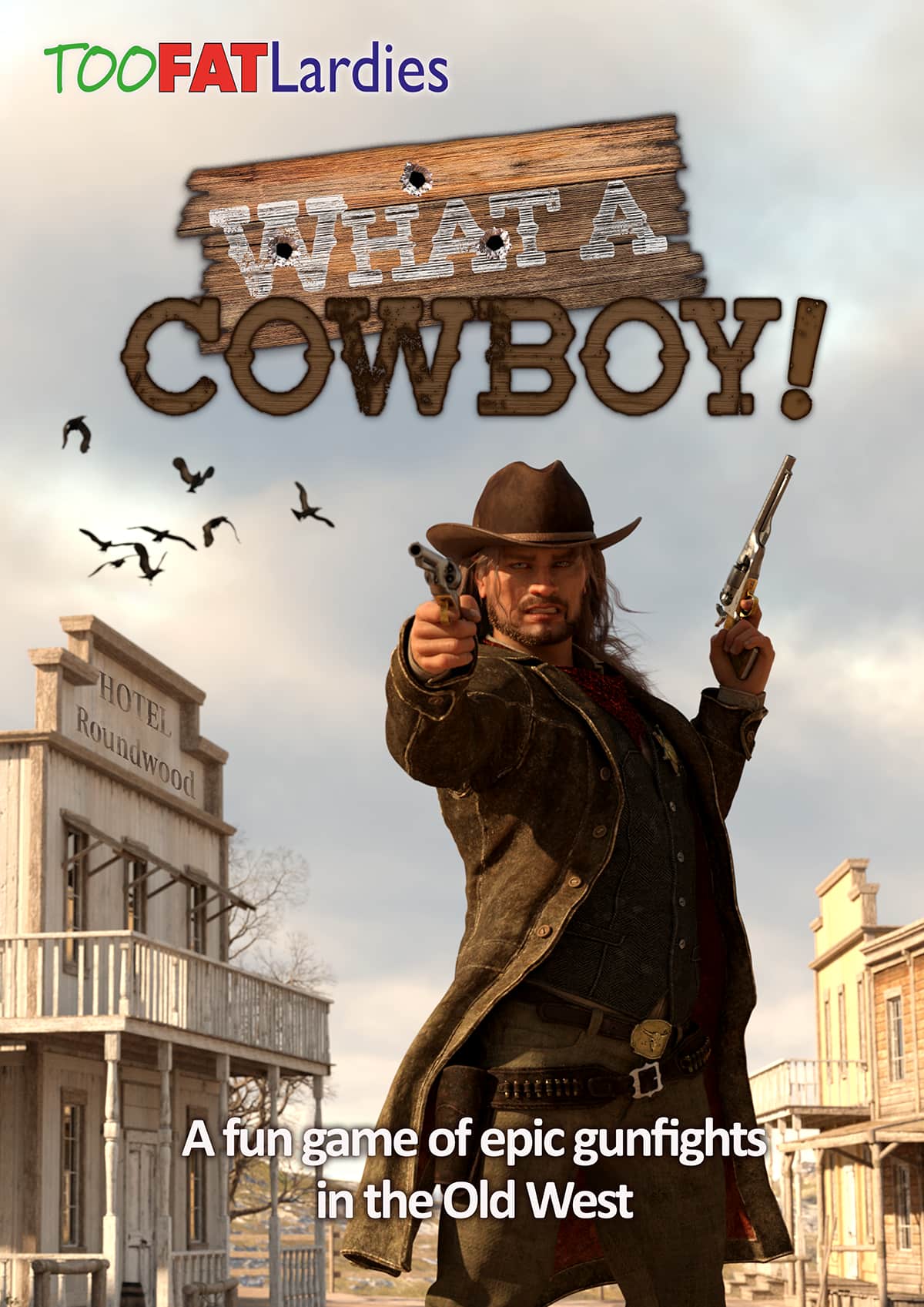
What a Cowboy

Cowboys and Indians! Something I would never think of Wargaming. So what was the draw for playing this game? Excuse the pun here. Firstly, I am a fan of games published by the Two Fat Lardies. These Western rules are based on an earlier set of WWII tank rules, What a Tanker, written by Nick Skinner, which John Savage has adapted to the Wild West. The Lardies had also published several tutorial videos before the game's launch, some excellent marketing, which also whetted my appetite. Last, the game was causing a stir on several Facebook groups I subscribe to. However, whilst the game appealed, I remained unsure of the genre, so my test game had to be done on a budget.

What a Cowboy Cover


Wargaming in a Budget

Thankfully, the game requires a few figures, usually four aside. However, I followed the Lardies' tutorial videos and used two figures on each side. I decided to invest in a box of plastic cowboys, allowing for any expansion. The terrain was assembled from my existing collection of rocks and a ruined temple that became a burnt-out mission. I added some cardboard buildings, which I did not use. Overall, the cost was less than £30.

Rules 

I intend to refrain from undertaking a detailed rules review, but some of the main mechanisms that give the game its flavour are worth mentioning. Overall the rules are simple to learn and intuitive, with minimal referral to the rules book.


Action Dice

The core mechanic is the action dice, six d6. These can be reduced during the game, mainly from being wounded. When rolled, these dice provide the possible actions the figure can take. These range from moving, spotting, aiming and shooting/reloading. This simple mechanism leads to many decisions when managing your character but leaves some uncertainty. This fog of battle also makes the game suitable for a solo wargamer.

Ammo Tracking

A nice touch is that the ammo is tracked for each gun or rifle the figures carries, with some of the better firearms being restricted to the more elite characters. The mechanism means that you have to plan when it’s time to reload, which can be a tricky decision.

Role Play

Another element that gives this game its flavour is role-playing in character design.

The Test Game

I developed a quick backdrop to my test scenario to give flavour. The two sides were after the loot of  Joshua Dawson, a small-time conman who struck gold on his last venture, only to die a few weeks later. The first group interested in Joshua’s legacy were his two sons, Eli and Zac. The Dawsons love their biblical names.
Their opponents were two minor outlaws, Jingo Bains and Hank Rodgers, whom Joshua had swindled out of their illegal gains. Therefore Bains and Rodgers felt cheated and determined to recover their 'hard worked' loot.  
Joshua's ill-gotten gains lay hidden somewhere in the old missionary church. The game objectives for both sides were to find the gold and get out in one piece.


Eli and Zac Scramble towards the Old Mission

Hank takes a Pot Shot at Zac


Action

The game played really well, and the rules were easy to pick up as my two small teams fought around the old ruined missionary station to win the treasure. A fistful of movement dice allowed the brothers to get to the loot first. However, in the interim, our rogues had managed to take up positions that would make it difficult for Eli and Zac the get back to their horses without a hail of gunshots.  Both would suffer wounds before they reached their horses, and it was some bad timing by Hank that forced him to reload at a critical moment that allowed the Dawson brothers the few seconds they needed to get to safety.


Follow-Up - 5 Years Later

The game was fun, and the Dawson brothers will be saddling up again. I have decided to use the campaign rules included in the book to carry my story forward. The brothers have used their father's money wisely and now own a cattle ranch, Repeta, that sits outside Dawson Greek. A town, as the name suggests, that owes the brothers a lot. Eli and Zac will be joined by other members of the Dawson clan. More to follow. 


Monday, 20 February 2023

Age of Sail


As I mentioned in an earlier blog, my first venture into Age of Sail was to bring the battle of Cape Ortegal to my tabletop. More about the action later, but it was a small action, fought between two squadrons, twelve ships in total, rather than a significant fleet action. However, my ambition is to refight the great clashes of the era, Glorious 1 July, Nile, Copenhagen, and Trafalgar, so the rules I choose ideally should accommodate these significant engagements. This focus eliminated many rule sets that focused on ship-to-ship duels.

A broadside


Rules and Constraints

The first step in my quest involved reading several rules sets to establish which ones appealed. Rules that a wargamer chooses are a personal choice to fit their requirements. Three constraints impacted my selection. First, I have limited space, so any option had to be played on a 6’ x 4’ table. Second, I mainly play solo, so any dedicated rules to aid solo play would be attractive. Last, I wanted to test the period with a limited financial budget. This led me down 1:2400 scale ships. Although War Artisan card ships tempted me, I thought they were too large because of my restricted space.

The Rules

I had previously tried tabletop board games, like the Sails of Glory and Oak and Iron, but they did not allow me to recreate large engagements. Therefore, I concentrated on five sets of rules.

Grand Fleet Actions (GFA) by Andrew Finch and Alan Butler, A & A Game Engineering,

Far and Distant Ships (FDS) by David Manley, Long Face Games,

Fighting Sail (FS) by Ryan Miller, Osprey Publishing,

Fire as She Bears (FASB) by Phil C Fry, Starboard Tack Press,

Kiss Me Hardy (KMH) by Nic Skinner, Two Fat Lardies.

Please look at my earlier post for site links for these rules.

Period Covered

Before looking at the individual rules, a few general comments. First, only some of these rules covered the same period. Kiss Me Hardy is focused on the ‘Age of Nelson, whilst GFA and FASB can be used to refight engagements from the 16th Century. Fighting Sail is the most restrictive covering the 18th century and the first two decades of the next century. Therefore, most of these rules can cover a period from the Anglo-Dutch wars to the end of the Napoleonic conflicts.

General Comments


First, most rules are pdf downloads that you must print if you want a hard copy. The notable exception is Fighting Sail from Osprey, produced to that company’s high standard. Few of these rules are indexed, and only FDS and FS have a QRS sheet. However, QRSs can be found online and in various Facebook groups for most of the rules. Fighting Sail and KMH have the best online support with dedicated forums and Facebook groups. All the rules have online tutorials to help land lubbers like me learn the rules. The naval arena is poorly served compared to the plethora of excellently produced rules for Napoleonic land battles. This is best illustrated by the lack of templates (movement and gunnery) needed to play the games. Only KMH has commercial templates, so in most cases, homemade solutions are required.

None of the rules has dedicated solo extensions, although the activation system, card or token driven, in Kiss Me Hardy makes solo adaptation easier. Although I have not tried it at this stage in my research, some of the ideas on command in a KMH supplement can be transferred.

Initial Thoughts.

Whilst the rule might be lacking in swish presentation, they make up for it in playability. Most rules are quick to learn that concentrate on the command aspects rather than the details of seamanship. This design approach produces some friendly mechanisms and improves playability. Boardgames Geek scored most rules below 2.50 out of 5.00 on complexity.

Play Testing

My initial thoughts on my read-through and some limited play testing are,

Far Distant Ships (FDS)

Designed for significant naval actions, they are low complexity, quick to learn and have the advantage of no off-table bookkeeping. The rules played like a DBA game, so opposing dice with a handful of modifiers. This led to a fast, easy-to-learn game that captured the problems faced by the age of sail fleet commodore. The advanced rules that include a signal system would undoubtedly add to this impression and the fog of war.
My main criticisms are that the rules would have benefited from detailed examples of some key concepts. Secondly, the carronade fire at close range is lethal, but there is no information on which ships carried them. However, these comments on ship details apply to all the rules I reviewed. The excellent site is the best starting point for most enquiries.

Two free scenarios, Glorious 1st June (1794) and Camperdown (1797) are available. Beyond these two scenarios, the rules currently need more online support.

Fire as She Bears (FASB) 

A Medium-complexity game designed to fight fleet actions. However, it involves off-table bookkeeping, limiting the number of ships that can be handled in solo play. One annoying feature is the rules is that examples are found in a separate download file making referencing awkward. A significant downside is the special basing requirement (octagonal bases) that will limit future options if you are still experimenting.
There is a limited number of scenarios. The Trafalgar extension contains four scenarios, including Cape Ortegal, but I am still looking for other official scenarios. Overall, an excellent rule set for a club where players command a squadron of six to ten ships.

Kiss Me Hardy (KMH) 

Designed for fleet and single-ship engagement, with low complexity but requires off-table bookkeeping. I found KMH more enjoyable with some excellent mechanisms that, when played, would quickly become intuitive. The British and the Americans have the highest quality, the ‘Jolly Jack Tars’, whilst the French forces, ‘Sans Culottes’, are average. Poor Spanish crews get the lowest category, ‘Land Lubbers’. Further customisation can be made using Brian Weatherby's ‘Messing around with Boats’ article in the Lardies’ 2011 Magazine. Generally, the British have better crews, but the French have bigger and better-gunned ships.

However, this customisation comes at a cost, off-the-table record-keeping. Although this is not onerous, it does impact the number of ships a single player handle. Another potential downside is that the initiative is driven by cards, which are unavailable commercially. So, a home production job is required. However, movement templates are available from Warbases or the game’s supporters on Facebook. These templates make movement more straightforward than the other games I examined.

Fighting Sail (FS) 

An Osprey Wargames book, so the best-presented and most straightforward rule I examined. However, they need more feel for the era but are actively supported, and enthusiasts have filled in several of the weakness. Therefore, with some research, you have an easy-to-learn game that covers fleet actions and frigate duels with no bookkeeping. Overall, the rules are streamlined, but for me, they leave some historical flavours behind.

Grand Fleet Actions (GFA)

Aimed at squadron and fleet actions and have a similar feel to FDS. But the detail incorporated in these rules is impressive. However, I found these rules more challenging to learn than FDS. For this reason, I nearly abandoned them, but on the second reading, I decided to keep them on the playtest list. The authors state that you need a squadron of ships to benefit from their rule design, so there are better engagements than Cape Ortegal to do them justice.

Playtesting and Interim Conclusions

The game I set up was a simplified Cape Ortegal, with three 3rd Rates, one 80 guns and two 74 guns per side. The wind, as in the battle, was from the northeast. The simple objective for the French side was to leave the northern edge of a 4’ by 4’ table, which the British had to prevent.

Unfortunately, I won't be able to provide a detailed battle report that will be saved for the refight of the actual engagement. However, the test battles played out similarly, with the French failing to break through the British blockade. In both games, the French lead ship, Duguay, suffered substantial damage, and in Kiss Me Hardy, the French flag, the Formidable, struck her colours. The British ships did not go unscathed and received significant damage to their rigging, which nearly allowed the French squadron to escape.

Which Rules?

In brief, I liked both sets of rules, FDS and KMH. I think KMH are the more evocative of the period, but the recording limits the number of ships a player can handle. Between 8-10 ships, so whilst refighting Cape Ortegal is possible, they would not stretch to more significant engagements, although for clubs with several players aside, this is possible.

I will use KMH for the more minor engagements because of the extra flavour they bring to the gaming experience. FDS has a DBA feel and lends itself to the more significant battles. Then there is the slow burner among the rules I explored, GDA. These rules, like FDS, will come into their own in more significant clashes, so I plan to further playtest FDS and GDA, probably by replaying ‘Calder’s Action’.

Overall, whilst the genre might lack visually appealing rules, it makes up for it with some clever design mechanism that allows replaying the naval battles of the era as a commander rather than getting swamped by sail settings, etc.

French Ships spot the British Line

A Boardside leaves to Confusion

London Chronicles – Gaslight, Rift-Tech, and Supeheroes

Welcome to the dawn of my new campaign environment - London in 1880. For a while now, I’ve been tinkering with a setting that has refused to...