Showing posts with label Pulp Alley. Show all posts

Thursday, 4 June 2026

The Leopard Campaign: Scenario Two – The Man in the Wagon

A Spy’s Warning

It all began with a note smuggled out of besieged Plymouth.
The message was brief but alarming. An important Royalist prisoner, Sir Edmund Vine, was to be moved from the city under heavy guard before being transported to London for interrogation. Whatever information Vine possessed, the Parliamentarians clearly considered it valuable. The note also revealed the prisoner’s route and identified the ideal ambush site—a small market square through which the wagon would pass before descending the narrow road leading to the East Gate.
The Leopard’s orders were straightforward: rescue Sir Edmund before he disappeared into Parliament’s prison system.
(For the Leopard earlier adventures - start here.)

Woof Cutting of thhe Leopard

Wood Block Cutting of the Lepoard dating from the 1650s

The Morning of 17 March 1643


Before dawn, while most of Plymouth still slept, the Leopard and his companions slipped into position amongst the alleys and buildings bordering the square. In the distance, they could already hear the rumble of wagon wheels and the steady tramp of marching feet.

The trap was set.

Springing the Ambush


As the wagon turned into the square, the Royalists melted deeper into the shadows. Surprise would be their greatest weapon.
The vehicle concealed its precious cargo beneath heavy canvas, but the escort was formidable enough. A burly sergeant led a dozen Plymouth militiamen through the early morning gloom. Once the wagon reached the market cross at the centre of the square, the Leopard struck. Musket shots echoed between the buildings, scattering several of the militia and leaving only the hard-bitten veterans to protect their prisoner. The ambush had worked. For a brief moment, the odds seemed firmly in the Royalists’ favour.
The Leopard and his men surged forward before the escort could recover.

Edgar and Billy - The Other Mission


Not everyone was focused on the rescue. Edgar and young Billy had been tasked with locating a series of intelligence caches left by Royalist agents within the city. Unfortunately, those dead drops lay dangerously close to the fighting. Worse still, shots suddenly rang out from upper windows overlooking the square.

Parliamentarian snipers.

The city authorities had anticipated just such an attack. Or perhaps someone had betrayed them.

Chaos in the Square


Isaac—rarely far from a bottle and never far from trouble—attempted to shoot the wagon driver. As the company’s best marksman, success should have been assured. 
Instead, the shot flew harmlessly wide.
Whether the fault lay with the musket, the weather, or the previous night’s ale remains a matter of debate. Giving up with the musket, Issac abandoned subtlety, gripping his musket like a club and charging towards the melee. He managed only a few strides before slipping spectacularly on the wet cobbles and crashing to the ground.
The square itself soon became an unexpected ally of the Royalists. One of the wagon wheels struck an uneven cobblestone, jolting the vehicle violently and forcing the driver to halt while he regained control.

The Leopard wasted no time.

His men closed in from all sides, surrounding the stalled wagon before the escort could react.
Unfortunately, the remaining defenders proved far tougher than expected.
I am running a few minutes late; my previous meeting is running over.

At their centre stood Sergeant Hopgood.

A giant of a man and a former blacksmith, Hopgood wielded his halberd with frightening skill. Again and again, he held back both the Leopard and Maarten, his sweeping blows forcing them away from the wagon. Meanwhile, Edgar and Billy searched desperately for the hidden intelligence caches while dodging musket balls fired from the surrounding buildings.

A Runaway Wagon

Eventually, the driver regained control and urged the wagon forward once more. Suddenly. James and Isaac found themselves directly in its path. James threw himself clear at the last moment and even managed to grab briefly at the wagon’s side. Isaac was less fortunate. Still suffering from the effects of the previous evening’s drinking, he reacted too slowly and was knocked sprawling by the vehicle. The unfortunate marksman was left unconscious in the mud.

Recognising the danger, Maarten broke away from his duel with Hopgood and launched himself at the moving wagon. Somehow, he managed to cling to the side before disappearing beneath the canvas cover.

Inside, a desperate struggle erupted.

At the same moment, James seized his opportunity. As the wagon slowed, he hurled himself at the driver, dragging him from his seat. The driver’s whip caught James across the face, but a well-placed thrust forced the man from the reins.
The wagon ground to a halt once more.

The Tide Turns


As the fighting intensified, a sea mist rolled in from Plymouth Sound. Visibility dropped dramatically, reducing friend and foe alike to shadowy figures moving through the fog. 
The snipers abandoned their positions and moved closer to the wagon, sensing that the battle was reaching its climax.

Yet through it all, Sergeant Hopgood remained immovable.

Time after time, he blocked the Leopard’s advance, swinging his halberd with relentless determination. Although neither man could gain a decisive advantage, Hopgood’s stubborn defence prevented the Leopard from joining the struggle around the wagon. Then faithful Edgar intervened. Creeping through the confusion, he stepped quietly behind the giant sergeant and struck him from behind.

It was not heroic. It was not gentlemanly. It was, however, extremely effective. Hopgood collapsed.

Escape from Plymouth


Rain now began to pour from the darkening skies, turning the square into a treacherous mire.
Inside the wagon, Maarten finally succeeded in freeing Sir Edmund Vane. Escorted by Billy—who had also recovered another intelligence package from a Royalist agent—the rescued prisoner was hurried into the maze of alleys beyond the square.

Church bells began to ring. Shouts echoed through the streets. The alarm had been raised.

But by then, the Leopard and his companions were already disappearing into the narrow lanes, heading towards a safe house and the secret tunnel beyond.
Only Edgar was left behind.


The Angel and the Drunk


Somehow, Edgar evaded capture and eventually staggered into Lord Hopton’s camp. Demanding a drink to ease his wounds, he claimed that a dark-haired angel had rescued him from certain capture before he awoke aboard a cart bound for Saltash.
Whether anyone believed him is another matter entirely.

Post-Game Thoughts


This proved to be an excellent scenario, with momentum swinging repeatedly between the Royalists and the Plymouth militia. At one stage, I feared I had made the rescue too easy for the Leopard. Then Sergeant Hopgood appeared and almost single-handedly turned the battle in Parliament’s favour. He was one of those wonderful emergent characters that occasionally appear in solo gaming—an NPC who unexpectedly develops a personality simply through their actions on the tabletop.
Hopgood will almost certainly make another appearance in the campaign.
Once the wagon had been stopped for the second time, however, the initiative shifted decisively towards the Royalists. From that point, the rescue became increasingly difficult for the defenders to prevent.
The one change I intend to make when running the scenario again is to introduce militia reinforcements immediately after Sir Edmund is freed. That should add a greater sense of urgency to the escape phase and create a more dramatic finish.

Campaign Reflections

The game itself was a success, but the wider campaign structure remains a work in progress.
The Snakes and Ladders campaign map has not performed as well as I had hoped. Despite additional mechanics and dice rolls, it still produces a largely linear sequence of scenarios.
Likewise, while the scenario generator consistently creates interesting ideas, it still requires considerable development before each game and struggles to create a strong narrative connection between scenarios.
These elements will need some revision before the campaign continues.
For now, however, the Leopard has secured Sir Edmund Vane and the intelligence he carries.
The question is what secrets the rescued agent knows—and where those secrets will lead our adventurers next.

Saturday, 3 January 2026

Workbench 2026


Workbench Picture

As we turn the page on another year of gaming, it's time for my annual look back at what's been happening on the tabletop here at Anglian Wargaming HQ.

Looking Back at 2025

2025 turned out to be a pretty productive year, even if I didn't manage quite as many games as I'd hoped. I wrapped up two campaigns that had been running for a while: the pulp adventure 'Tomb of the Serpent' using Pulp Alley, and 'DNA', a superhero romp played with SuperMission Force.

The real star of the year, though, was Midgard. This sandbox game arrived late in 2024, but didn't make it to my table until March. Since then, it's dominated my gaming time and sparked my largest 28mm painting project in years. I've run several Dark Ages games with these rules now, and I'm currently deep into my first Midgard campaign: Mystic Britain. This pits Arthur's Britain against the Durlingar dwarves and their allies. The campaign should reach its climax early in 2026, though after the evil dwarves' latest victory, the outcome is far from certain!


The other campaign I started in 2025 was 'The Spectacular Adventures of the Leopard', set during the English Civil War in the West Country. This follows Edward Clement and his band of followers as they battle against the Preacher and his Parliamentary Forces. I'm using the ever-versatile Pulp Alley rules for this one, with the campaign plotted using a simple Snakes and Ladders board game.

What's Coming in 2026

I've got two new campaigns lined up for the year ahead.

First up is a 'steampunk' superhero campaign in which the Keepers of the Hidden Ways take on the Charnel Society in their inaugural adventure. I've been having great fun developing this alternative London, complete with a female Sherlock Holmes and her colleagues with their supernatural abilities. This will be a straightforward linear campaign with three or four scenarios making up a 'series'. The aim is to capture the feel of comic books, with new supervillain teams appearing in each chapter.

The second campaign is historical: Edward I's conquest of Wales, based on a Charles Grant 'programmed' reconnaissance campaign. Set in 1277, the English probe the Tywi Valley and meet resistance from the Welsh lords of Deheubarth. Historically, these events were a sideshow to Edward's main invasion in the north and led to the region's submission. I'm planning to use Baron's War 2nd Edition rules, with a spring start once 'Mystic Britain' campaigns wrap up. One thing I've learned is that I can only handle two concurrent campaigns – any more and I lose track of the narratives.


Projects and Ambitions

One disappointment in 2025 was not getting more historical simulations to the table, particularly following the refight of the Battle of Pynda using the Strength and Honour rules. These games need considerable research to do correctly, plus there's often significant modelling and painting involved. I plan to streamline this by focusing on 6mm or 10mm miniatures where my collection is strongest. Cynoscephalae is nearly ready for the table, and this time I'm going to experiment with different ancient rules to see how they handle these battles.

Looking further ahead, I'm working on a crusader army list and rules using the Midgard rules. With luck, I'll have something to share by year's end. I'm also converting my trial WoFun War of the Roses figures into a 10mm army, though I'll squeeze in another quick game as the army comes together.

Two longer-term projects are still in the research phase. The first is a Kiss Me Hardy campaign based on the Jack Aubrey novels, though this depends on the new edition of those rules. The second is a Glorantha project based on the wonderful RuneQuest world. The idea is to follow a small group of characters through roleplaying, skirmish games, and finally as part of a unit in mass combat. Plenty of reading and testing ahead on both fronts!

The Blog and Beyond

The blog is starting to get some decent traffic, but I want to develop it further. I'm currently looking at sharing more scenarios and campaign logs. I also write a bit of background material for my games and would like to share my thoughts on wargaming mechanisms more generally. I'm not convinced the blog is the best format for all this material, so I'm exploring Substack as a way to complement the shorter content here. More on that later.

Here's to another year of dice rolling and tape measures!​​​​​​​​​​​​​​​​


Monday, 15 December 2025

Ashes and Secrets - The Leopard Campaign Begins


I have finally begun my Leopard Campaign, inspired by the Portable Wargames Compendium and
played—somewhat madly—on a modified Snakes and Ladders board. Traditionally, the system is used for competitive two-player campaigns, but with a few small tweaks, it works beautifully for solo play. The board generates narrative “fortune” events and strategic setbacks—perfect for civil-war skulduggery. 
Some background information on the campaign can be found here.

The Leopard

Orders from Plymouth


The opening entry of the campaign takes place in early March 1643. The Leopard—Royalist adventurer, spy, and occasional trouble-maker—is tasked with recovering a packet of papers hidden in the burned-out shell of Emmington Manor, east of Plymouth.

A favourable die roll landed him on a fortune square, giving him the option to delay departure and acquire aid. Rather than press his advantage and out-move the Parliamentarian patrols, the Leopard opted to recruit Joseph Widecombe, a Level-1 scout with an uncanny knack for avoiding trouble… or at least postponing it.

Marching Through the Mud


The ride to Emmington was quiet. Warm westerlies rolled in, softening the March weather but drenching the countryside with heavy rainfall. After several days of slow riding, the Leopard and his troop sighted the manor below—a charred ruin nestled in a muddy valley, its fields ruined and livestock long gone.

Dismounting, they advanced on foot. The yard was clogged with fire debris, and the thick mud made staying mounted a hazard. Muskets loaded, eyes sharp, the Leopard spotted shadowy figures edging through the distant fields.

The plan was simple: get in, get the papers, get out. Yet plans involving human beings seldom survive first contact. Isaac—still suffering from the previous night's ale—slipped face-first into the mud, punctuating his fall with an enormous fart. The rest of the troop wasn't much better; every step was swallowed by the mud. 

Issac, take the 'hair of the dog' before the battle

Closing Net of the Militia


Despite the mire, the Royalists reached the manor just as the local Parliamentarian militia—led by the Hon. Samuel Massey—began closing in. Fallen beams and half-collapsed walls turned the interior into perilous terrain.

The Leopard crept into the manor itself, while his loyal companion Edgar, formerly a cryptographer and now his most dependable retainer, searched the outbuildings.

Extract from Edgar's Diary — 3 March 1643 

"Mistress Fortune favours fools and Clements alike. The yard is a bog, the house a tomb, and Isaac a menace to nose and nerve. I searched the barn first—old habits die hard; one always checks the margins. There, amid wet ash and pig-sties, I found a loose plank concealing a rusted casket. My heart leapt. But I heard shots then, close. The militia was upon us. I fear today will be an ugly day, and the papers we seek may be the least of our concerns."

Shots in the Yard

Musketry erupted as the militia loosed a ragged volley. The Royalists returned fire with surprising discipline, scattering some of the greener conscripts. Tougher resistance came from the militia advancing through the fields—though here the mud proved to be an ally for both sides, slowing movement and blunting charges.

Inside the manor, the Leopard strained to free a heavy beam pinning an old chest. After a tense struggle, he succeeded, tearing free the bundle of documents. Objective complete… or so it seemed.

Ambush at the Rear 

The militia attack was only a distraction. The militia's captain, Samuel Massey, and a small group had circled behind the manor, cutting off the Royalist escape route. Widecombe was struck down almost immediately in the Parliamentary counterattack. Young Billy, seeking safety over valour, fell back to help hold the yard.

Only Maarten, the Leopard's old comrade-in-arms, remained to block the surprise attack. He met the militia leader in a fierce sword-lock. Though evenly matched at first, Maarten slowly began to press the advantage—each blow struck with decades of battlefield experience.

Across the fields, Isaac—alcoholic haze finally lifted—managed to wound one of Coombs's men. The skirmish devolved into a muddy melee, halberd against musket butt. Yet numbers now favoured the Royalists.

Fate delivered the final blow: Sergeant Coombs slipped in the mud, striking his head against a wall and collapsing senseless. With their leader down, the remaining militia broke.

The Royalists Escape


With the papers secured and the militia in disarray, the Leopard rallied his troop. Despite the mud, the confusion, the flatulent mishaps, and the ambush, the Royalists fought through and escaped toward their own lines. 

A strong start to the campaign—though danger came far closer than the Leopard had hoped. A couple of extra "turn cards" let the Parliamentarians tighten the noose, and despite the campaign rule limiting shooting while moving, the skirmish saw far more musketry than expected.

But in the end, the Leopard's superior blades—and superior 

Follow the adventures of the Leopard in besieged Plymouth - here


Monday, 1 September 2025

Enter the Leopard – Swashbuckling in the English Civil War

Meet Edward Clement, better known as the Leopard – spy, adventurer, diplomat… and perhaps a forgotten pretender to the English crown. He is the star of my forthcoming Pulp Alley campaign set during the English Civil War, and he promises to bring cloak-and-dagger intrigue to the smoke of musket fire.


Edward Clement, aka The Leopard, spy, adventurer, diplomat
 and a forgotten pretender to the English Crown.


But where did this character come from?

The seed was planted when I stumbled across Hans Holbein's famous painting of Sir Thomas More and his family. In the background, half-hidden in a doorway, stands a mysterious young man clutching a scroll. The art historian Jack Leslau argued that this figure was Dr. John Clement, husband of Margaret Giggs, More's adopted daughter, and, more controversially, that Clement was in fact Richard of Shrewsbury, the younger of the lost Princes in the Tower. 

Thomas More and Family

Thomas More and Family with Richard of Shrewsbury
in the doorway to the right.

That idea lit my imagination. What if a descendant of Clement survived into the seventeenth century? A man of mystery, royal whispers in his bloodline, stepping into the storm of the Civil War? Thus, Edward Clement – the Leopard – was born.

The Leopard's Story


Edward Clement was educated in the Low Countries and at Cambridge before entering Prince Rupert's service during the Breda campaign of 1637. When Rupert sailed for England in 1642, Edward followed, quickly catching the attention of Edward Hyde, one of Charles I's most trusted advisors. 

Court gossip puzzled over his sudden rise. Whispers of noble blood surrounded him, but Hyde saw only a helpful agent – if one with dangerous ambitions. By 1642, the Leopard had become an indispensable spy, navigating the murky shadows of the King's quarrel with Parliament. 

In early 1643, he was dispatched west to aid Sir Ralph Hopton, taking up the role of chief intelligence officer. There he crossed swords with an old nemesis: Aaron Bell, the fiery Puritan preacher who had sworn to unmask him.

The Fellowship of the Claw


Of course, no pulp hero stands alone. The Leopard commands a league of loyal companions known as the Fellowship of the Claw – a ragtag band of allies, rogues, and survivors.
  • Young Billy – a nimble-fingered street urchin with quick hands and quicker charm. 
  • Fletcher – the Clement family's old gamekeeper, a deadly shot when sober, a liability when not. 
  • Edgar – the family's secretary and fixer; once a courier of secrets and master cryptographer, now a dangerous old man who knows everyone's business. 
  • Maarten van Asbeck – a bastard son of a Dutch noble, long-time comrade of Edward, hardened by the Thirty Years' War. 
  • Milo Crumb – the hapless adventurer, often lost, often in trouble… and yet somehow always stumbling into discoveries, such as the coded Parliamentary note he found when his head struck a low beam. 
It's a cast straight from the pages of a penny-dreadful – perfect for pulp adventures.


The Leopard and the Fellowship of the Claw, from the right, Billy, Fletcher, 
Edgar, the Leopard himself and Maarten. Milo had fallen into a hole.


Bringing the Leopard to Life 


This campaign utilises Pulp Alley with only minor tweaks, many of which are inspired by the excellent community on the Pulp Alley Facebook group (special thanks to Ira Gossett and his Three Musketeers adaptation).

The Campaign Board

The backbone of the story will be a custom Snakes and Ladders campaign board. Each die roll pushes the Leopard and his companions closer to their ultimate goal – but hazards, detours, and dramatic trials lurk along the way.

The Scenario Generator

Initially, I wrote a dozen full scenarios to be played in random order, but that proved too rigid and sometimes broke the narrative. A sprawling table system followed, but that became clumsy and overcomplicated.

The final version is much sleeker: a single 3D6 table that generates mission, location, primary objective, and complications all at once. Optional tables for minor plot points and enemy leagues add spice to the game. The result feels flexible, surprising, and – crucially – keeps the narrative flowing.

Testing is underway, and I'll share the draft ideas soon. 

Enter the Leopard


The Leopard is ready to stride into history – rapier in hand, cloak billowing, secrets close to his chest. Over the coming weeks, I'll be posting more about the campaign's mechanics, introducing some other characters, including the stunning and cunning Amelie St. Simon, a noble spy, and her reckless brother, Andre. Then, the villain of our campaign, Aaron Bell, the Preacher, is a Parliamentarian spymaster with hidden ambitions. These introductions will be followed by a series of battle reports where Edward Clement and the Fellowship of the Claw take the stage. 

Adventure awaits. Will the Leopard rise as a hero of the King, or fall as another forgotten pretender? For the first chapter in a story, press here.

Maarten and Katie
Maarten and his love interest, Katie Reed. 
One-time prostitute now a kicken maid in Lady Hopton's household.


Wednesday, 12 February 2025

Pulp Alley & The Leopard

I recently finished my Tomb of the Serpent campaign. My next project is the Spectacular Adventures of the Leopard, a swashbuckling skirmish game set during the English Civil War. I have already played a test game, The Wayward Messenger, using the 7TV system. However, before setting out on this project, I decided to review what rules were available and which best suited my needs. Finally, I decided to use Pulp Alley. So why am I using a set of rules designed for the first half of the twentieth century for a historical skirmish game? As the Pulp Alley authors made clear, the Pulp genre included a wide range of environments, including gangsters, superheroes, fantasy, horror, and pirates, to name a few. So, in this first missive on my Leopard project, I will examine the rules I have looked at and why I went for Pulp Alley. As you will see, this is a very personal choice that fits my circumstances.

Leoprad Cover
The Leopard, Aurelia St Simon and Aaron Bell (The Preacher)


Seventeenth Century Skirmish Rules. 

There are several good rule sets dedicated to the swashbuckling period, such as Flashing Steel, Glorie, and En Garde, to name just a few. All these games provide an excellent narrative for my campaign, but none are designed for the solo wargamer. Also, why I love collecting and reading rules; for my day-to-day gaming, I try to keep to a handful of core rules. Therefore, I decided to have a set of skirmish rules that  I could use for Indiana Jones-type adventures, gangsters in the 1930s and classic sci-fi settings. This led me back to the Pulp genre.

Pulp Rules - Cost 

In recent years, the pulp genre has become rather crowded with rules. Compared to other periods, all these rules can be obtained cheaply. Most have a free version or can be downloaded cheaply from Wargames Vault. 

Also, the figure count is usually less than a dozen, and most figure rules are agnostic in what figures can be used. Pulp Alley and 7TV have figure ranges, but they are unnecessary for playing the games.

Various supplements, scenarios, and cards add additional costs. Pulp Alley and 7TV have the most support for their games, so more supplements and cards to add to the core game. If you decide to go 'all in' with cards and supplements, this makes them the more expensive end of the spectrum.

The most significant cost is the need for nice-looking terrain. However, card buildings are available, and with careful planning, MDF and resin buildings can be used for other games.

Pulp - The Rules

Here is a brief summary of the rules I have examined. Click on the rules picture for link to the rules.

7TV (Crooked Dice)

7TV Rules

7TV was designed to pay tribute to 1960s and 1970s television, focusing on campy adventures from fantasy to science fiction. Initially, each genre had its own supplement, but in 2023, Crooked Dice produced a core rulebook and now concentrates on producing serials (scenarios) that reflect the TV shows of the era.

The gameplay emphasises thematic missions and cinematic effects. Players build “casts” of characters using customisable archetypes. These are played on a set where the game recreates a TV episode. This can lead to odd play; for example, the set can move due to continuity errors.


Fistful of Lead (Wiley Games)

These rules are simple and quick to learn, perfect for fast-paced pulp action. They focus on minor skirmishes with individual character actions. The action deck (standard playing cards) mechanic introduces randomness and variety. The game offers flexible genre support, including Westerns, noir, and pulp sci-fi. Experimental solo rules, which are free to download, have been produced. Although their strength lies in multi-player games where they can handle numerous players (c. 10) without the game getting bogged down.

However, Fistful of Lead does not produce a deep storytelling experience, and the characters are underdeveloped for my tastes. I also found them challenging to customise for my Leopard adventures, although several genre/period supplements are available.

Perilous Tales 

This cooperative skirmish wargame centres around horror and exploration, perfect for Lovecraftian or supernatural pulp settings. The procedural scenario generation and simple yet thematic rules create cinematic challenges and a story-rich encounter, and they are specifically designed to support solo and cooperative gameplay.

Character design is limited because it is driven by predefined templates, which limits the customisation of games outside the horror genre. While all the games in this list are designed to create cinematic cliffhangers, in this instance, the mechanism that produces the excitement seems random, making tactics less critical than other pulp games. However, as a free game that introduces someone to pulp or for solo play, these rules are a winner.

Pulp (Osprey)

Pulp is one of the latest entries in the pulp stable and part of the Osprey Blue Book of wargames. Like all Osprey publications, the rules are cheap and well-produced. The rules offer a fast, streamlined game that is easy to learn, making it a good entry-level game. However, in terms of simplicity, the rules have lost depth in customising the characters, who are limited to archetypes.

Therefore, they miss the full storytelling potential of the genre with limited narrative depth and minimal customisation of characters.


Pulp Alley

Pulp Alley provides deep narrative gameplay, using dice and card mechanisms to represent plot points and random events. Together, these components produce an easy-to-learn game that is difficult to master. As I mentioned, the rules are designed to be highly customisable and fit with the variety of pulp genres. Character creation is good, although I would like more depth added to the character's background.
The game has solo rules and a unique card deck that produces engaging and exciting games, and it has one of the best dedicated communities of any game. The authors produce weakly, at least, videos to support their creation. While the cost is moderate if you want to purchase the cards (downloads are available), it provides an immersive experience into the world of pulp.
  

Comparing Pulp Rules


The rules choice is personal and designed to meet your or the club's needs. Therefore, the list below is designed to meet my gaming needs. I have considered the following factors: Narrative, Complexity ( I like simple to moderate rules), Flexibility, Solo play, Costs, and game/community support.

Narrative

My games must produce a good narrative that could make a good short story. In this category, Pulp Alley, 7TV and Perilous Tales edge this for me. The card mechanics in the first two add much narrative depth to the game.


Complexity

None of these games is particularly hard to learn; most are moderate to low in complexity. Boardgame Geek rates them in the mid-2s out of a total of 5. Fist Full is Lead, and Perilous Tales may have simpler systems.


Flexibility

Pulp Alley and 7TV can support any pulp genre. Pulp Alley nudges this category because 7TV's scenarios are more scripted.


Solo Mechanism

Only Pulp Alley and Perilous Tales have dedicated solo mechanisms. The other games' systems focus primarily on competitive skirmishes, so solo players must develop their own systems.


Cost of Entry

As I mentioned at the opening of this blog, the cost of entry is relatively low for this genre. 7TV is the most expensive, although they have merged most of the genre into one core book, reducing costs. Pulp Alley offers a lot of free stuff, but it will increase if you want to buy the cards and other add-on costs. For those on a tight budget, Perilous Tales and Fist Full of Lead, with downloadable rules and a few add-ons, have the edge on costs.


Support

One of the oddities of solo Wargaming is that you still want to feel part of a wider community. Therefore, online support is an essential aspect of the game for me. Support includes activity communities, forums, and online engagement. In this respect, Pulp Alley wins out with its Facebook community, weekly videos, and games.


Conclusion

Pulp Alley was the final choice for playing my Leopard campaign because of its flexibility. I only had to make minimal changes to reflect seventeenth-century technology, its solo-play capabilities, and the production of a strong narrative. In my Tomb of the Serpent campaign, the characters became more 3-dimensional as the story progressed. However, here, I had to design my own adventures, so I wanted a clearer picture of the background of my main characters. How the Leopard, his friends and foes came to life will be the subject of the second blog in this project. 


Saturday, 4 January 2025

Tomb of the Serpent God - The Final Chapter

The blazing sun of the desert had barely faded from memory when our band of adventurers emerged from a portal in the heart of a desolate land. In the shadow of a cursed tomb, their hopes of finding Sir Francis, Thwaites, and Marjib had crumbled into the dust. Alfie, clinging to life, was carried to a nearby village, where he made another miraculous recovery. His pale, haunted expression betrayed that fate had not finished with him.
Ever the leader, Slade secured the aid of a local guide, Menrit, to navigate the foreboding temple that loomed over their mission like a viper coiled to strike. With each step closer to the Snake God’s lair, an oppressive dread hung heavier. 

The Mace Insitute


The Antechamber

Their journey brought them to the temple’s antechamber, smothered in shadow and silence. Slade’s torch sputtered to life, casting flickering light across the crumbling masonry. A great stone door barred their way, its surface carved with strange glyphs that seemed to slither under the torchlight. As Slade heaved it open, the brittle structure groaned in protest, sending a jagged chunk of stone hurtling toward Honey. She narrowly sidestepped it, her breath catching in her throat.

Tomb Entrance

The Entrance to the Snale god's Prison/Tomb


The Writhing Wall

The corridor beyond was long and narrow, its walls crawling with a sickly green luminescence. Daphne leaned closer, her eyes narrowing at the source of the eerie light. “Beetles,” she whispered, her voice tinged with disgust. “And not the friendly kind.” She reached out, brushing her fingers against the writhing insects. The cold struck her like a dagger, and she jerked her hand back, trembling as a pallor overtook her face.


Maat - The Despoiled Goddess of Balance

Further in, they came upon a plinth crowned by a statue of Maat, the goddess of balance, her scales shattered in a cruel mockery of justice. At her feet gleamed a massive ruby, a beacon in the darkness. Slade, ever daring, stepped onto the slippery surface, his muscles taut as he pried the gemstone free. Relief flooded the group as he retreated unscathed—until a harsh scraping noise echoed deeper within the corridor.

Scorpions 

Before anyone could react, a monstrous scorpion burst from the shadows, its claws snapping and its tail poised to strike. Honey’s pistol barked in defiance, the shots briefly staggering the beast before it lunged, swatting her to the ground. Slade and Alfie rushed to her aid, their weapons hammering the creature until it collapsed in a heap of chitin and ichor.


The group pressed on, but their trials had only begun.


The Defenders of the Tomb

Slade was the first to enter the inner chamber, and the stench of decay hit him like a wave. From the gloom emerged the risen priest, his rotted form shrouded in malevolent power. Slade fired, but the bullets ricocheted harmlessly off the creature’s ancient armour. As the priest loomed closer, rubble stirred at the room's edges, disgorging skeletal warriors with rusted blades.


Slade Versus the Risen Priest

Slade fights the Risen Priest in the Outer Chamber. A Combat that would last to the end of the scenario

Daphne and Alfie fought valiantly as Honey and Menrit struggled to regain their footing. Each step forward was met with fierce resistance as more undead clawed their way from the temple walls. Just as hope began to waver, the Ankh Amulet around Slade’s neck flared to life, its golden light coursing through him. Empowered by its energy, he fought with a ferocity that turned the tide, forcing the priest back. Yet the creature refused to fall, its unholy vitality mocking their every effort.

Then came the final test.

Burial Chamber

Alfie stumbled into the burial chamber first, but an unseen force struck him down, flinging him back like a ragdoll. His limp body sprawled across the chamber floor, another cruel twist of fate in his harrowing journey. The burden now fell to Daphne and Honey. With Menrit holding the line against the horde of undead guardians, the two women edged closer to the sarcophagus of Apophis himself. 

The Inner Chamber

A Tomb Guardian awaits in the Inner Chamber, soon joined by several undead warriors.

The air was heavy, thick with ancient malice. Each step was a battle against the slippery floor and the oppressive force radiating from the tomb. At last, they reached the god’s prison, their voices trembling as they recited the ancient ritual: The Rite of Ra.

As the final words echoed through the chamber, a golden light burst forth from the tomb, its brilliance piercing the darkness. The black, writhing mass within shrieked and writhed as it dissolved into nothingness, its malevolent presence banished at last.

But as the dust settled and silence reclaimed the temple, one question lingered: had the Snake God truly been defeated, or had they merely opened the door to something worse.


Postscript

Three weeks later, the team sat in the shaded gardens of the British Archaeological Society, sipping ice-cold drinks. Alfie had once again recovered from his injuries. Mr Indestructable was Daphne's nickname for him now. Sir Francis, Thwaites, and Majib were reunited with their friends when they crossed the portal in the temple. After sealing the portal, the group returned to Cairo. As they relaxed, the society's director expressed the British government's thanks but added that the breach caused by Aphosis and his disciples had set off some unexplained incidents, including those in the Nile and Sudan. 

Whilst Sir Francis had to return to London accompanied by the ever-faithful Thwites, the others decided that their work in Egypt needed further study.
 

Final Remarks 

The final game lived up to its build-up. Daphne and Honey managed to complete the final plot. As the campaign progressed, the characters began to take on life and became more three-dimensional. The ever unluck Alfie with his soft spot for Daphne, the daredevil amongst the gang. Slade became a solid if a bit of a brooding presence, and Honey became the girl who was never flustered.

We will hear more about the Mace Institute soon, but next, we will move our Pulp experience to turbulent seventeenth-century England.


Monday, 9 December 2024

The Burning Desert

This is the fifth part of my Pulp Alley, Tomb of the Serpent campaign. After the ambush at the oasis, our heroes have been forced to abandon their vehicles and proceed on foot. Carrying the remains of their supplies, they find it hard going. The one advantage they have over is Majib, the Arab foreman that they had rescued from the destruction at Professor Remi's camp. The tall Egyptian knew the ancient way the poor Professor was trying to unearth. As they approached a narrow valley, Farouk waved the party to silence. He whispered, ' This place is cursed.'

Mace Banner


The Landscape 

This extract from the future Lady Daphne’s diary provides a vivid description of the cursed valley that the team entered,

The gorge was narrow, and despite the heat, the dark walls ran with stagnant water. Thankfully, this oppressive environment was short, and it quickly opened into a valley flanked by rocky outcrops. On the valley floor, there was evidence that the valley would have been fertile in the past; now, it was a place of death.

As we entered the valley, we could see a temple at its far end, which was largely submerged in the desert’s sand. As we would discover, the rocky valley at its southern end gave way to treacherous sands.

Let's Get the Hell Out of Here

The heat in the valley and obsessive, sucking the air from our heroes. Looking up at the rocky peaks, Slade did not like it and feared an ambush. ‘Let’s get out of here’, and started to jog towards the ruined temple at the other end of the valley. Slade’s assessment was correct as a gunshot rang out, and blood began to pour down Slade’s arm, thankfully only a graze from the bullet. The party looked up and saw more of the tribesmen they had encountered at the oasis appear from the rock outcrops.

The party moved as quickly as possible, but the shots came from both sides of the valley, slowing them down as they exchanged fire. Suddenly, Alfie slumped and a red pool of blood spread from his right side. Daphne immediately dropped to his side and tried to comfort him. It seems Alfie's rotten luck has continued. Stabbed in Italy, then stung by a scorpion in Cairo, once again, it seemed his life was held by a tread.


Honey and Thwaites take cover.
Honey and Thwaites take cover from the shots fired from the rocky outcrops.


Dangerous Sands.

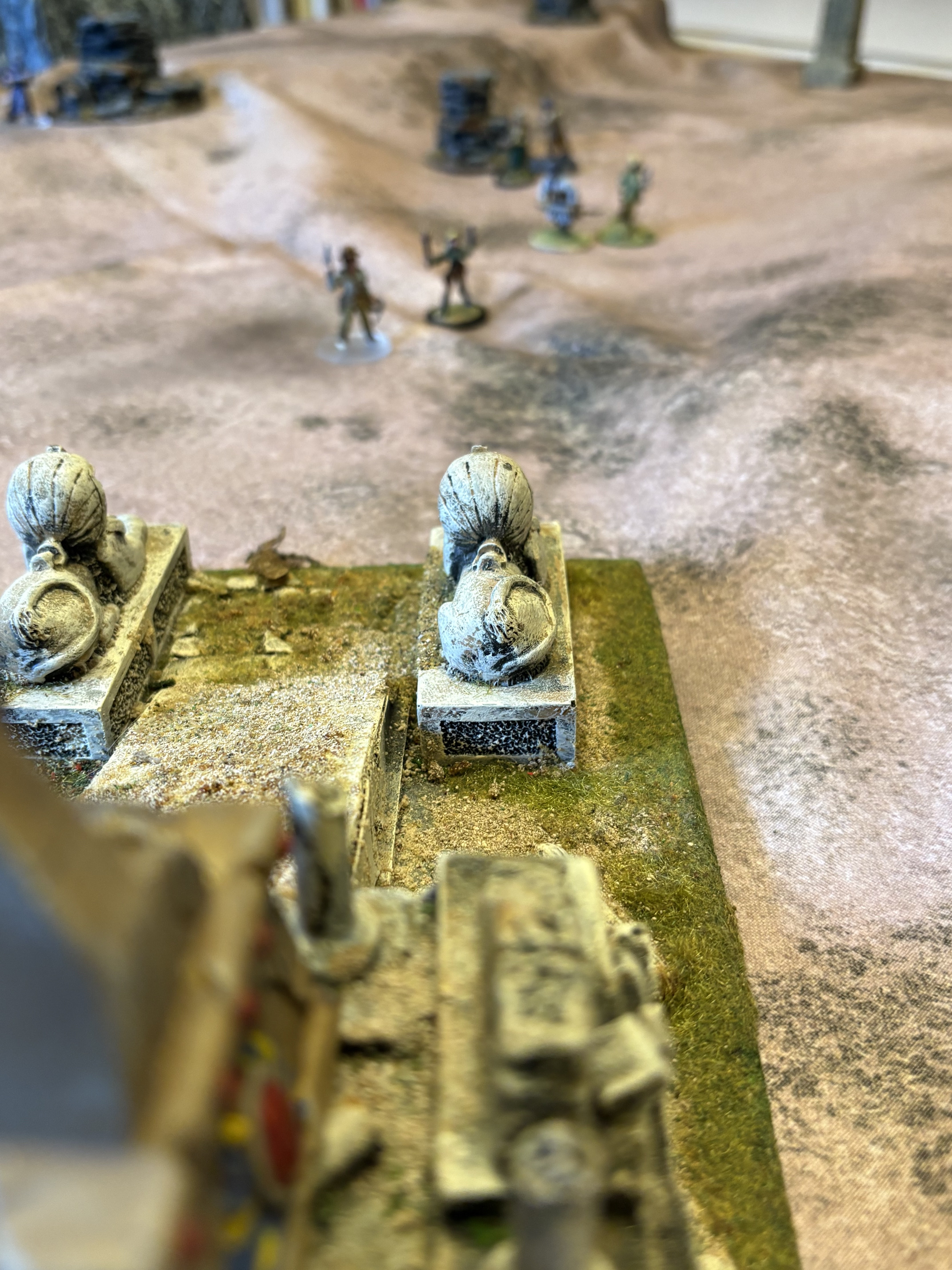
Slade was the first to reach the ramp that led up to the temple. Ducking behind one of the sphinx guards, he felt his foot being sucked into the sand. Grappling hold of the statue, he heaved himself up and got a shot off at the horde of tribesmen approaching from the west. Sir Francis and Thwaites were more unlucky, and both found themselves knee-deep in the sand. 

Daphne was the first to reach the top of the ramp. Her youthful education in ballet classes and gymnastics had served her well. As she passed into the darkness of the temple, she shouted, 'There is some form of portal here. I can make out some buildings on the other side. ' 

The dash towards the Temple
Our heroes make a dash towards the Temple.


Thwaites Sacrifice.

Things were getting worse. Two giant scorpions dragged themselves out of the sand and joined the ever-increasing number of cultists.  Meanwhile, Sir Francis had extracted himself from the treacherous sands. The guide, Majib, was not so lucky and was stuck by a bullet and slumped forward. Thwaites grabbed the man and started to haul him from the treacherous sands to the bottom of the ramp. Meanwhile, Honey had jumped through the portal. Slade, now at the edge of the temple, provided covering fire as Thwaites tried to pull Majib up the temple ramp.

As escape looked possible, a cultist threw himself at Sir Francis and his fellow stragglers. Thwaites, seeing the threat blocking the attack, told Sir Francis to run. Slade and Sir Frances, seeing the gate closing, had no choice but to throw themselves into the closing portal. 

A Costly game.

I thought my League of Heroes had an easy time with this scenario. The tactics were solid, and I was lucky with the cards drawn. Most were low-level enemies, insane mobs, and cultists of various forms. Even when the giant scorpions emerged, it was too late for them to play any critical role. The biggest problem my heroes faced was the perilous sands surrounding the temple.

Even allowing for my heroes' luck, this was a costly scenario with three team members eliminated from the final conflict. Young Alfie, life hangs in the balance, whilst Thwaites and Farouk are lost somewhere in the ether. More importantly, these were my brawlers, and their loss will make the team unbalanced. More of a shooting party that is about to enter the confines of the Snake god's tomb.  Maybe Alfie might recover, but that is for the final chapter of this adventure.

For the Final Chapter, press here.


Tuesday, 14 May 2024

Caper at the Oasis


Archie’s teeth chattered, not from cold but from the bumpy desert track. Their convoy had left Alexandria four days prior, navigating the western deserts on the so-called desert highway.

In the lead, Slade Horton's jeep carried the girls and Sir Francis. Beside Archie, Thwaites struggled with the truck’s wheel, cursing as he negotiated the vanishing track. Suddenly, Horton halted the jeep and announced, ‘It's on foot from here, folks. Grab what gear you can. Professor Remi’s camp lies beyond those dunes. He may guide us through this wasteland.’
New Age Comic Issue 4

Mace Institute Cast

Professor Remi's Camp

Thankfully, according to the Archaeological Society in Cairo, the professor's camp was nearby. Professor Remi’s party had set out months ago to trace an ancient Egyptian sacred way leading across the Western Desert to the Nile. Their last known position was at the ominously named Serpent’s Shade Oasis, now visible with its bright blue waters.

Approaching the camp, the group sensed trouble. The air turned dense and sickly. Daphne doubled up, vomiting and collapsing. Sir Francis rushed to her aid while the rest cautiously advanced. Equipment scattered around the seemingly abandoned camp hinted at violence.

Tribesmen, Cultist and a Nasty Priest

Horton signalled the team to spread out. As they did, tribesmen approached, prompting them to regroup. Despite Horton's warnings, Alfie charged, sparking a violent clash with some tribesmen. Muscular men wielding scimitars joined the fray, injuring Thwaites and forcing everyone to fight for their lives.

As the battle raged, a serpent priest emerged, casting curses and launching attacks. Despite their desperate struggle, the heroes found themselves overwhelmed. Daphne and Alfie were targeted by the priest's dark magic but overcame his evil spell. 


The Hawk’s Cry

With casualties mounting, a sandstorm loomed on the horizon, freezing the assailants in hesitation. Seizing the opportunity, Daphne escaped, the priest’s clawed hand, as the storm engulfed the camp, its roar reminiscent of a hawk's call echoing in the chaos. 

Desperate Measures - Our Heroes fight for their lives.

Majib

After the storm passed, Sir Francis discovered Majid, Professor Remi’s foreman, unconscious. Majid recounted an attack by a half-serpent, half-man creature; he did not know the fate of Professor Remi and his brothers. Seeking revenge and his missing brothers, Majid joined the party on their journey.

The story continues. For the next chapter, press here.


Endnote

The story starts here if you want to recap the group adventures in this campaign.

Only two more games to play in this mini-campaign, although that depends on the journey across the desert. This is the first game in which our heroes would have lost if the game had continued for a few turns. Thank you for this lucky escape, the fortune (solo) version.

One of the fun things about the campaign is how the characters develop. The two junior members of the party, Daphne and Archie, have started to become more 3 dimensional. During this campaign, Archie nearly dies, is stung by a scorpion, and, in this last adventure with Daphne, becomes the story's hero when they hold the Serpent Priest at bay.

I am already working on the next adventure, based on an old game, for Department E6 of the Mace Institute. Also, a more mature Daphne and Archie are planned to appear in my Weird World War II adventure.

Overall, it was great fun. In my mind, that's what wargaming should be about a good narrative storyline that holds the games together and characters that come alive and are fun to play.


Sunday, 14 January 2024

Workbench 2024

This blog is always self-indulgent because it aims to set out my projects and ambitions for the forthcoming year. A similar bit of self-indulgence occurred last year, although personal circumstances made many of my ambitions attainable. However, it would be wrong to blame the vagaries of life on my failure to deliver all my projects last year. The most crucial factor was that I was too ambitious, a common trait with wargamers. Therefore, this year, I have been more constrained in my aims; although the project list is still as long, some will not see the light of day during 2024.

Workbench Graphic

Campaigns


Last year, I had two campaigns that I planned to play during the year. The first was a fantasy campaign, the Second Shadow Wars, using the rules of the Fantastic Battles. This campaign saw little action since the early months of 2023. First, the campaign took an unusual turn when Umbarji Khan ( my Orcs ) suddenly died, leading to a succession crisis. I had not drawn up the maps for all the Umbarji realms, nor did I have detailed biographies of the various brothers and sons that would contest the Blood Throne. Finally, I needed rules to cover these surprise developments. 

I have learnt from this campaign to stop trying to develop everything myself and take some of the work the other enthusiasts have placed on the web. Therefore, I plan to play the Umbarji Civil War by adapting some one-page campaign rules and personality-driven mechanics in Henry Hyde's 'Wargaming Campaigns'.

In the meantime, the original campaign centred on the Wilderness Steppes will concentrate on the struggle for the Lakeside towns. Due to his father's death, Ozbeg has been drawn into the struggles with his family and has left the Wilderness campaign to one of the leading generals, Doba Skullcrusher, to conduct the war on his southern border. Again, this will involve looking at off-the-shelf campaign roles, using a hex system, or even returning to such old favourites as Mighty Empires

The Tomb of the Serpent

The second campaign used the Pulp Alley and their Tomb of the Serpent campaign.  This is now halfway through, and I plan to complete this during the year. Slade Horton and his companions from the Mace Institute are now crossing the desert in search of the Serpent’s tomb, where they will come face-to-face with the Egyptian God of chaos, Apophis. I have fallen in love with this band of adventures and plan to translate them to other game systems, so expect to see the Mace Institute appear in alternative World War II adventures. 

Mace Institute

Recreating Battles.

I have two recreations near completion in painting and research, and they will hit the table in the first quarter of 2024. The first is the Battle of Crediton in 1643, where I'll reenact the battle using the Twilight of Divine Right rules, and maybe another replay, using For King and Parliament. 

Marius and the German Invasion

The next set of battles re-fight the battles between Marius and the Germans, Aquae Sextiae (102BC) and  Vercellae (101BC). These will be played using Strength and Honour rules. However, these battles are essentially holding games whilst I start to work on the big projects of 2024, Hellenistic World and Rome's Expansion. Why start this new development? 

Partly anticipating Mark Backhouse's supplement to cover this early period; it is my favourite era of Ancient History.  The main difference is this era will be played using 6mm figures rather than 2mm because I have a box of painted minis that have been unloved for several years. Rebasing and some in-filling of figures will be required, but hopefully, this will not be too burdensome. Unsure of the first battle, try to get to the table, but the following are on the list: Paraitatiene (317 BC), Ilipa (206 BC) and Pynda (168 BC).

Wellington in the Peninsula 

This project was on the list last year and is slowly progressing in 2 mm. 2mm is ideal for this era because it gives the authentic flavour of the mass movement of large bodies of men across the battle field. Once the painting is completed for the Battle of Vimero (1808), moving on to the other conflicts of the Peninsula campaign will be easy. 


Lion Rampart, Saga and Midgard 

The one campaign I completed last year was my Feud campaign set in the period before the Magna Carta. I plan to turn my interests to the Early Medieval period, where I will experiment with several rules, including Lion Rampart, Saga and yet-to-be-released Midgard. All three games have the potential to play a Fantasy version, so I may dig out some old 28mm Citadel miniatures to set up some small-scale fantasy battles. I plan to have some extra stuff painted by the excellent Matt Slade to give some of my old armies a new flavour. Ultimately, I may extend these one-off battles into some form of campaign. I'm interested in doing an alternative breakdown of Roman authority in Britain. Where the invaders may have been dwarves and their allies. 

Skirmish Games and Roleplay

Besides using Pulp Alley for the Tomb of the Serpent campaign. I have employed 7TV to bring the swashbuckling character of the Leopard to life as he fights his way through politics in war and the time of the English Civil War. I plan to join these adventures together and publish them as a set of scenarios. 7TV system is also being used for my Sword and Sandles project where a Greek demi-god will take on numerous quests, a mixture of Xena, Sinbad and Jason and the Argonauts. However, this idea is still in its early days.  

Superhero Genre

The last area skirmish is superheroes. In 2023, I played the first part of my mini-campaign when the evil Dr Nicholas Amargus (DNA) attempted to brainwash San Diego with his mind-bending gases. I adapted Pulp Alley for this first game, but for the second instalment, I will use Super Mission Force, which is designed for the genre using the gaol system. While these adventures are going on, I am building two teams of superheroes from the Golden Age who will fight Hitler's minions. 

Dungeon and Dragons

Connected to the skirmish games is my renewed interest in role-play, where the character develops even more. A magazine I found in the supermarkets made me to re-look at Dungeons & Dragons. I have found that since I last role-played – in the 1980s- enthusiasts have done much work on playing solo adventures. I plan to use these ideas and employ AI as a tool to help the game master.  I hope to post a blog on my thinking behind this and how it can generally impact wargaming. 


Naval 

I am planning a small Kiss Me Hardy game based on the scenario in one of the Lardies' magazines that is set off the island of Corsica. I am still struggling to find a set of ancient naval roles that reflect the era's sea battles. At the moment, I'm tempted to take up one of the ideas that came out of a discussion between Henry Hyde and Simon Miller of using To the Strongest mechanism for naval engagements. This could be a large project if I decide to undertake this challenge. Whatever, nothing is likely to appear next year. 


Some Final Thoughts

No doubt, as a wargaming magpie, some other distraction will draw me off in an unforeseen direction. Games Workshop has re-hacked the old Epic 40,000 as Legion Imperialis. A reminder of time playing Warhammer, so I am likely to give the game a try. No doubt there will be others.

I also hope to attend a couple of shows and a 'Lardie Day'. Whilst, I remain mainly a solo warmer, the hobby has a fantastic community that always gives me a boost. However, these events often provide the seeds for another project. Chain of Command has lingered in the back of my mind since my outing to Nottingham last year.


Diomedes and the Cyclops. Extracts from the Lost Book of Hesiod.

The Quest So Far After leaving the valley of fantastically beautiful flowers ( Episode 1 ), our heroes found the landscape becoming steadily...