Saturday, 7 May 2022

The Feud

This wargame had a long gestation period. It took three Kickstarters plus many hours of painting before I have managed to get Baron’s War to the table. Barons War is a medieval skirmish game set in the thirteenth century.  The game was initially launched on Kickstarter in 2019 with figures for the Barons revolt against King John. Since then, further Kickstaters have followed, including several campaigns. Overall, the game is well supported and has supplements for the late Saxons, Vikings, the Norman Conquest, and the Crusades in Outremer.

A range of figures is also available through Footsore Miniatures. The miniatures paint up well, but like any medieval project takes a while to paint. This is my excuse for taking nearly two years to set up a game. The good news is the game can be played with about 25 figures aside, although a more significant skirmish can be fought as your retinues grow.


Skirmish on the Evesham Road.

Like all my games, there has to be a  strong narrative, so here is the backstory to the game. One aspect of the game I like is the campaign rules allow you, the players, to generate a grievance between the two warring barons and the flashpoint that ignited the armed hostilities. My campaign is set before Magna Carta and is loosely based on the campaign supplement, The Most Ignoble Feud. Therefore, this scenario will be the first of three games in the mini-campaign.  I also plan to use this storyline to test different rules and my ideas. 


Rivals in the West Country

The period witnessed John favouring baron families from outside his English realm. One of these was  Gérard d'Athée, a trusted lieutenant of King John, who had served him in France and later as a High Sheriff in England. Gerald was joined by one of his relatives Engelard, one of the protagonists of our story, whom John had appointed High Sheriff of both Gloucestershire and Herefordshire in 1210. The rapid rise of these men caused resentment amongst the English baronage, including the de Cares, a powerful family. The father, Richard de Clare, was Earl of Hereford and his son, Gilbert, had inherited the earldom of Gloucestershire from his mother. It is Gilbert, the son, who is our other feuding baron.


de Clare Coat of Arms


Monastery at Haines

Engelard's attempt to found a monastery at Hailes, at the centre of the de Clare’s holdings, sparked our fictional feud. Gilbert considered this one transgression too far and decided to ambush Engeland and his monks on the way to Hailes on the Evesham road.


Evesham Road


The Ambush

In preparation for his attack, Gilbert had blocked the road with several carts and tree trunks, forcing the battle into the narrow area between the wood to the south and the hills to the north. He hoped his superiority in mounted knights would be most effective in this narrow killing ground. On hearing from his scouts that the road was blocked, Engelard deployed his experienced archers and foot sergeants on either side of the road to try to turn the barricade. His smaller mounted contingent would be used to exploit any weakness.

At first, Engelard's plan bore fruit; his archers, supported by some militant monks, pushed Gilbert's crossbowmen back from the small farm and started to move into the forest. If they could expel the de Clare's crossbowmen, they could be able to shoot onto the flanks of men manning the barricade. Englelard's men had yet to make progress on the road but had pinned down the rest of Gilbert's infantry. At this point, Englelard decided to commit himself and his mount troops to attack the open land between the road and the hilly area. This was the moment Gilbert had been waiting for, and he committed his mounted knight. The knight quickly crushed Engelard's mounted sergeants and attacked Englelard and his knightly bodyguard. Outnumbered and taking casualties, Engelard fled to seek his revenge on another day.


De Clare's Knight await their moment

De Clare attacks


The Rules and the Game

Overall, I liked the rules, and I thought I had a great feel and produced an exciting weekend game. My one criticism is that I found the rules difficult to reference, despite QRS (Quick Reference Sheet), but this is probably true of any new set of rules. I plan to continue Engelard's and Gilbert's feud with a significant battle when Englelard seeks revenge for the dishonour inflicted on the Evesham road. However, the next episode will be played with Lion Rampart rules, so I can compare. 


The Story Continues

The story of Engelard's and Gibert's feud continues here.


Links

Warhost is the home of Baron's Warand includes articles and a retinue builder.

Barons War Facebook Group. A discussion group with many great photos for inspiration, army lists and downloads.

Blood Cries Afar, well research but readable book on the 1st Barons War. Great for inspiration and ideas.
Tuesday, 8 June 2021

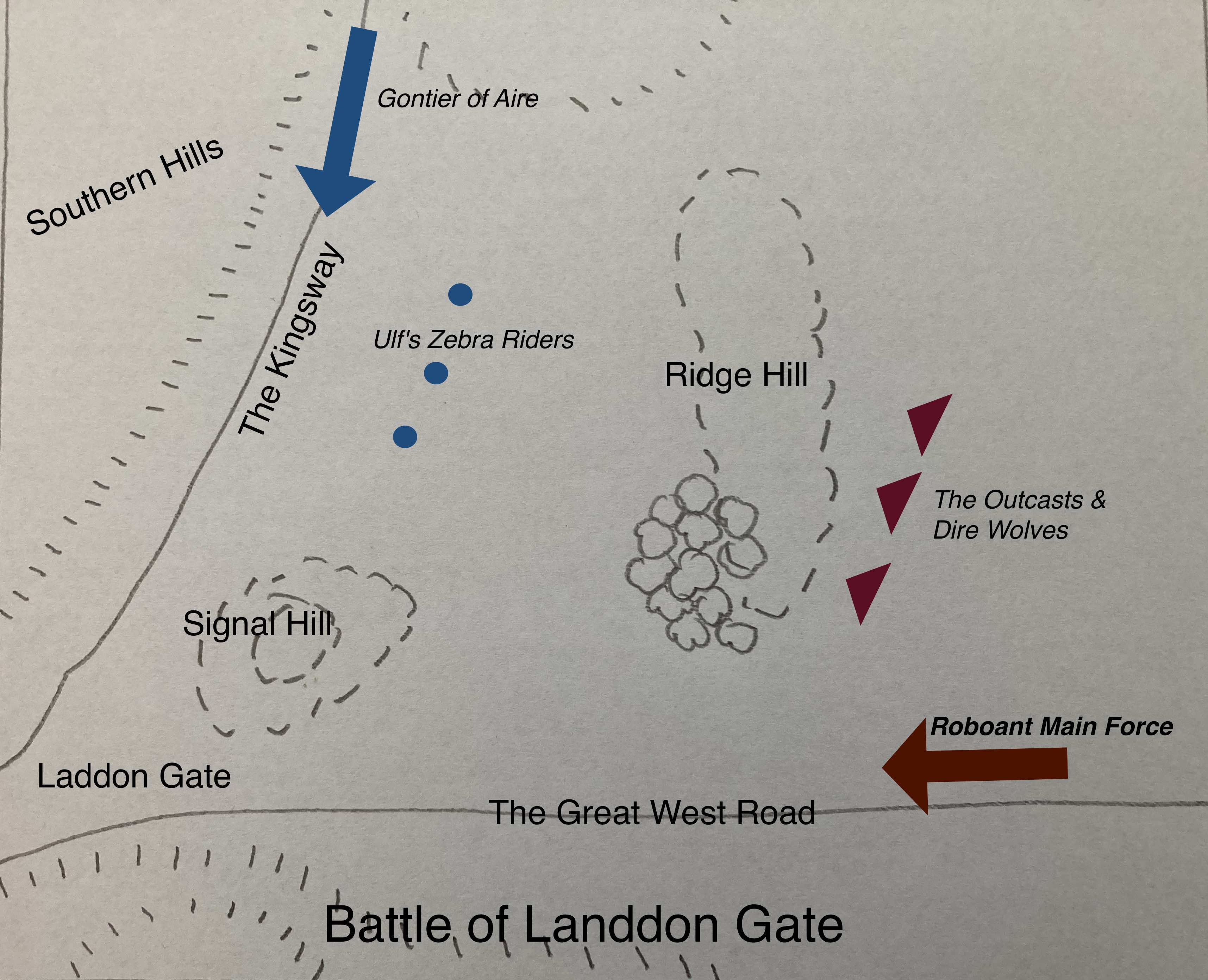
Battle of Landon Gate

This wargame is the first action of the Ancestors' Wars—a struggle between a High Medieval army and an undead warlord and his minions. It is the second strand of my Fantastic Battle campaign world.  I wanted to try a battle between two uneven armies in this scenario and based it on Charles Grant’s Programmed Scenarios, the 'Hasty Blocking Position'. The medieval army’s objective was to hold and occupy a pass until news arrived that the main army had assembled. The former had 750 points, and the attacking undead horde 1250 points.

Scenario Rules

The rules were kept the same, but I gave both armies three turns to deploy. After that, a further six rounds would be played, plus a random element. This was achieved by a simple roll of d6 with odds, improving one pip each turn. This represented a messenger arriving with the news that the main army had assembled and was on the march.


Background

What do you do when the pretender to the throne is your long-dead great, great uncle, Roboant the Damned? This was the problem that faced Tancred III Montduras when he heard of the uprising. His response was to call the kingdom to arms. However, this would take time. Therefore, on a windy spring morning, a messenger was dispatched to Gontier, Lord of Aire and Marshal of the Foremark. The king's instructions were simple, delay Roboant’s host by holding the Landdon Gate as long as possible.

The Strategies

Roboant strategy was to send the third of his army to harry Gontier's army as it tried to deploy in the Gate. The bulk of his host would push down the southern road and break through the pass as quickly as possible.
Gontier's approach was to secure the pass, using Ulf's mercenary Kerradian light horse (Zebra Riders) as a defensive shield to protect his deployment of the vulnerable infantry. Once the defensive lines had been established around Signal Hill, he would make intermittent forays to disrupt the advance.


The Battle Plan


The Forces Arrival

Dawn brought the howling of wolves with it, and as the morning mists lifted in the east, shadowy figures could be seen in the distance. A pack of fast-moving dire wolves sped down the valley. Meanwhile, Gontier had sent the mercenary Ulf and his Kerradian light horse to cover the deployment at the Landon Gate.

Deployment Issues

Both commanders needed help moving their armies whilst changing from column to line. Although frustrating, this was an exciting part of the battle. The commanders were forced to move up a down the marching columns to keep units in command. A halted unit quickly caused a roadblock bringing chaos. This was a significant disadvantage to the undead army because it was more extensive, and the mindless trait slowed it. Roboant would spend the whole battle flying up and down the line trying to get his zombies and skeletons into the action.

The Advance

The problems with deployment led to the advance guards fighting largely unsupported (turn 3). The wolves had moved quickly through the woods and down the road and charged Ulf's screening force (turn 4). The developed melees saw the wolves slaughtered, thanks to some appalling dice rolls that led to a surrounding victory for Ulf and his riders.


Ulf's Screaming Force


Roboant's Dilemma

Roboant's slow-moving reanimated horde took too long to march to the pass. Haste spells helped, but there was a need for more necromancers. It was a mistake only to include one additional magic user—a note to other potential undead commanders. Summons spells may look attractive, but haste is vital to get your undead army into battle. The impact was that Roboant human allies, the Doomed Ones and the Outcast, separated from the main command structures. For a few vital turns, the attack depended on the role of the Impetuous Actions table because the Undead commanders were too busy throwing haste spells at the slow-moving column.


Robot on Giant Bat Mount


Main Attack

Finally, Roboant was able to launch his main assault. The Doomed Ones and the Disinherited (Undead Knights), supported by the remnants of the dire wolves, attacked Gontier's main body of knights. West of the Gate, in the centre of the battlefield, Ulf attempted to rally his riders. Meanwhile, Gontier's knightly rear-guard tried to prevent Skeleton horsemen from attacking the rear of the infantry column.


The Gods

Nine turns had now been played, and the game moved on to its random element. Throughout the game, the dice favoured Gontier. However, now the gods' will seem to move against him, and the die roll allowing him to withdraw never occurred. The knights faltered despite the freshly rallied sergeants (light horse) support. The zombie hordes and the Outcast brigands had entered the neck of the Gate. Gontier joined the lines of the militia spearmen as the zombie hordes stumbled into charge range. Now it seemed time was against the living, and the undead would push into the heartlands of the kingdom before the army was assembled.

The Miracle of St Emidius 

As the zombies moved in for the kill, the men started to shout, and on the southern hilltop, witnesses claimed they could see a ghostly white figure mounted on a white horse. At this moment, the earth began to rumble and shake (a random event- Earth-shaker), and standing became an effort. The two lines froze in position, unable to move forward due to the moving ground. A few arrows were let loose, but with an unstable footing, they had little effect. No one can say how long the battle halted, but it created vital minutes for the living.

The Battle Ends

The fighting continued after the earth shook, but on the next turn, a messenger arrived, and Gontier started to full-back along the pass. Roboant halted his advance, unwilling to be lured into a potential ambush. Also, the sun was now high in the sky, which was not a particularly good time for an army that liked the shadows.


Thursday, 6 May 2021

The Battle Of Blackthorn Abbey

Fantasy Wargaming is one of my main interests. The traditional mixture of the medieval setting with that magical element appeals. A genre that allows your imagination to create your own heroes, histories and fantastic places. Also, like many wargamers in the U.K., there is the influence of Warhammer with its gothic backdrop. However, my love for writing led me to create my own world, inhabited by its own unique people. Therefore, the rules I currently use for my fantasy wargaming are Fantastic Battles because of their design flexibility. A fuller discussion on fantasy wargame rules and why I chose Fantastic Battles can be found here.


Ozbeg the Maligned

Ozbeg the Maligned was not the most impressive of Great or White Orcs, but what he lacked in physical prowess, he made up with his cunning and his royal birth. His granduncle (Bulad the Bloody) was the last great kaumn (King of Kings) of the Western Umbarji (my Orcs). As usual, Bulad’s death in a raid against the city of Letharac led to the fragmentation of his empire. Ozbeg, a younger sibling of a minor concubine, inherited a small domain around the southern peaks of the Howling Mountains. A lordship that was on the fringes of the now-defunct empire. Reverting to the old Umbarji traditions of plundering and burning, Ozbeg provided his followers with the essentials of life; honour, war, blood, slaves and plunder. While his forces raided and slaughtered, Ozbeg continued to sow seeds of discord amongst his brood brothers. Slowly but steadily, Ozbeg’s horde grew from hundreds to thousands. His hunting lands gradually extended into the great northern plains of the Mammoth Steppes.


Lu’Lak -The Blood Shaman

Ozbeg attracted numerous orcs to his banner as his land grew, including the Blood soothsayer Lu'ak. Lu’ak saw in Ozbeg the potential for wealth and power and proclaimed him the living embodiment of Gijak Creveetor, the Umbarji creator god. The proclamation was heretical, even by Umbarji standards and potentially brought Ozbeg directly into conflict with his siblings. However, most were too far away and too busy fighting themselves to be worried about snotling like Ozbeg. Ozbeg’s semi-divine status attracted many discontents to Ozbeg’s banner. A lighting campaign to the south forced the lesser Umbarji (Goblins) tribes of the Bitter Forest to acknowledge Ozbeg’s hegemony. Ozbeg's ambitions turned to the south to the land of men and ogres. He started to raid the trade road, and the villages and hamlets clustered around the Lake.


The Attack on Marshport

The grass sea had just started to turn to bone-white in the summer heat when a bedraggled runner appeared in Strom Ironheart’s encampment. The man had come from the township of Marshport, where the Amber Way met the Lake's northern shores. The story the messenger told brought dread to Strom's soul. Raiding was a way of life on the Wilderness Steppes. Zebra riders attacked Elk people, Ogres tribes plundered their own and human kin, and occasionally the Umbarji appeared from their mountains to create havoc. However, the story of the Lake-man was different. He told of a strange rhythmic heartbeat that pervaded the night, a strange howling that he swore was in a demonic tongue. Then an incredible feeling of dread before the Orcs swept through the township. Left for dead, he watched his kith and kin, stripped of all their processions or being herded into the night. Those who stumbled were skewered and left to the birds and wolves.
Strom had seen the carnage of a Umbarji raid before, but they had never been bold enough to attack a lake settlement in recent years. However, it was still grazing season, and even if it was more daring than he would expect, one raid did not require the Great Summons.


Autumn Raids

During the autumn months, when the first snow flurries occurred, the Umbarji raids became a torrent. The lifeblood of the tribes, the caravans that crossed to the Steppe, faced constant attack. Even Lakeside, the largest township on the Lakes, had to fight off Umbarji raids.
Rumours from merchants said that a great Orc king once again led his people. For Strom, a young warrior, when Blud wreaked his chaos, his old gut rumbled with fear, and it was now the time to blow the Horn and summon the tribes.


To Battle 

Storm and his fellow chieftains had decided on caution because several tribes had yet to answer the call of the Horn. They decide to march to the ruined Blackthorn Abbey, where the Umbarji could be contained before they could damage the Wilderness Steppes trade routes more.


Battle Strategies

Strom planned to hold the centre and Shalak Hill that protected his left while threatening the inevitable Orc advance. The mighty Bison Riders on their right-wing would be the tribe’s offensive arm. They would overcome the Umbarji left and then threaten their central battle.
Ozbeg considered his options limited because he had already sent a third of the host home with the booty taken from the lakeside communities. His interests were to gain the relic within the abbey and to please his warriors, who wanted more blood. The massacring of merchants and their families had proved an unfulfilling pursuit. Therefore, Ozbeg's strategy was simple; use the meat grinder of Umbarji axes to smash through the centre. Let the boys have their blood reward while trying to refuse his flanks to the enemy. The manoeuvre would please his warriors and distract them from the mission to ransack the ruins in search of the relic.


Order of Battle

The Order of Battle

Opening moves. 

The battle opened with a rapid Umbarji advance, with the untried Ear Slicers (Umbarji had not severed the ear of their first kill, sometimes referred to in the human tongue as Youngbloods) leading the advance, keen to earn their first trophies. Strom held the Tribes position in the centre while probing the right and left flank.
An exchange of missile fire opened hostilities, but surprisingly, the first fighting occurred on Skalak Hill.  The Zebra Riders had clashed with the over-eager Forest Goblins. As swords clashed, magic crackled across the battlefield as the two battle lines advanced. Ozbeg, at this point, seemed to have the advantage because the Ear Slicers charged forward into the human's shieldwall that managed to hold. However, Rhino Riders on the right flank were slow and could not bring the Umbarji left flank to battle. Would the human centre hold out to allow the Bison Riders to start rolling up the Orc battle line?

Crunch Time

The Ear Slicers pressed forward, impervious to the Thangrian's (Hawkmen) fire, who tried to disrupt their advance. Inevitably, Umbarji crashed into the shield wall of the Stag Tribe with their guttural battle cries and their hunger for the kill. The central battle contact had come too early for Strom, so he threw in his mammoths to halt the Umbarji centre. Soon, the whole centre was engaged in ferocious fighting. Meanwhile, the Umbarji elite entered the abbey's crypt and searched for the relic. The only good news for the humans was that on Shalek Hill, the forest Umbarji chieftain had been killed, and his command was routed.

The Meat Grinder Arrives.


The Meat Grinder Arrives


Finally, the Bison Riders brought the Umbarji Gore Riders to battle. A brutal melee followed as both sides tore each other sheds.

The Heavy Cavalry Clash


However, as tusk and spear clashed, the struggle in the centre was concluding. The Ear Slicers finally gave way to the human shieldwall. Still, for the Stag tribe, the respite was short as the Lu'ak commanded the Bonecrusher's forward support with his magic. The charge quickly broke the shieldwall, and the human started to flee. Strom became caught up with the flight, having suffered a deep axe wound to his sword arm as he tried to lead his men to safety. 


The Tribes Centre Collapses

However, Ozbeg had little inclination to pursue; his Bonecrushers had been badly mauled. At the same time, his cavalry arm had routed. Besides, he had the relic and now knew that the human tribes were fragmented, something to discuss later with his warlords.

The Story Continues in the Battle of Spendle Moor.

Diomedes and the Cyclops. Extracts from the Lost Book of Hesiod.

The Quest So Far After leaving the valley of fantastically beautiful flowers ( Episode 1 ), our heroes found the landscape becoming steadily...